Silk Painting Workshop at the Embroiderers’ Guild

I haven’t tried silk painting before, so when I saw my local Embroiderers’ Guild were running a workshop I thought I would give it a try. The session was run by textile artist, Kirsten Yeates, from Denmark.

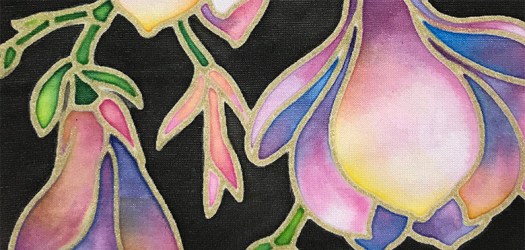
Kirsten began by handing out pieces of silk that had designs pre-drawn on them using gutta – a technique that creates a boundary that the inks can ‘bleed’ up to. Apparently it can be quite tricky to draw smooth lines of gutta so, as a beginner, it was ideal to be able to start with these pre-drawn examples. We were then given a short demonstration on how to apply the inks. A fine paintbrush and cotton bud is useful if you are painting a detailed design and a thicker soft brush if you need to cover larger areas with a wash of colour.

The silk painting inks are very concentrated and produce a really vibrant colour on the cloth. Painting with inks looked easy but the inks dry quickly leaving a hard edge of colour. To prevent this from happening you can either damp the fabric slightly with your brush, before applying colour, or water the inks down.

I’m more familiar with watercolours, so by diluting the inks I was able to create the effect of the colours softly blending in to each other. Here is the piece I made, before and after…

In a short two-hour session, these are some of the lovely pieces that the group produced.

For more information on the Embroiderer’s Guild, or to find your local branch visit https://embroiderersguild.com/

Loving Vincent exhibition – Het Noordbrabants Museum, Holland

Loving Vincent is a painted animated film based on 120 of Van Gogh’s paintings. Every frame of the film was handpainted by over 124 artists who created more than 65,000 paintings. The exhibition, held at Het Noordbrabants Museum in ’s-Hertogenbosch, Holland provided a delightful insight into the making of such an ambitious film.

Below is a selection of paintings on canvas complete with registration marks, frame number and production comments.

A close up detail shows how thick the paint was applied on some of the paintings, in the style of Van Gogh.

The exhibition included a 3D mindmap illustrating the thought processes behind the making of the film, from the initial resources used to the script writing and music choices, plus what ended up on the cutting room floor.

How did Vincent Van Gogh die? The film looks at the investigation following his death. The mystery board below shows the possible suspects and how how they’re stories connected.

For more information visit – http://www.routevangogheurope.eu/news/228-exhibition-loving-vincent-at-noordbrabants-museum

Visit to Dunham Massey, National Trust

Dunham Massey, in Cheshire, is an Elizabethan country house and deer park that is now run by the National Trust.

An old watermill in the grounds has recently been restored and opened to the public.

The leaves on the trees were just beginning to turn as autumn approaches.

One of the old trees lying on the ground had a very striking bark pattern.

The Motor House

When the 9th Earl of Stamford took possession of Dunham Massey in 1905 he instructed the conversion of the stables into a ‘motor house’. At the time only 16,000 cars were registered in the country and motoring was a hobby enjoyed only by the wealthy.

The Morris Ten-Four on display was a 1935 model, owned by Roger Grey, 10th Earl of Stamford.

The stables were sympathetically remodelled to retain many of the original features and character of the buildings. I particularly liked the texture of the brick wall…

…and the beautiful high timber-framed ceiling.

Chris Ofili tapestry: The Caged Bird’s Song

I visited the National Gallery in London this week to see the tapestry triptych designed by Chris Ofili, called ‘Caged Bird’s Song’. Wow! I had watched the documentary on the BBC about the background to the tapestry commission and how it had been made and I still couldn’t believe what I was seeing. The ability to produce a tapestry that captured the effect of a watercolour painting was amazing to see.

Looking close-up at the caged bird, the effect was stunning; the varying hues and blends of colour created a real illusion of light and movement.

Woven at Dovecote Tapestry Studio, Edinburgh, a team of 10 weavers had spent two and a half years hand-weaving the tapestry. On display at the National Gallery in London from April to August it will be on permanent display at Clothworkers’ Hall.

Next Generation Schools’ Day 2017

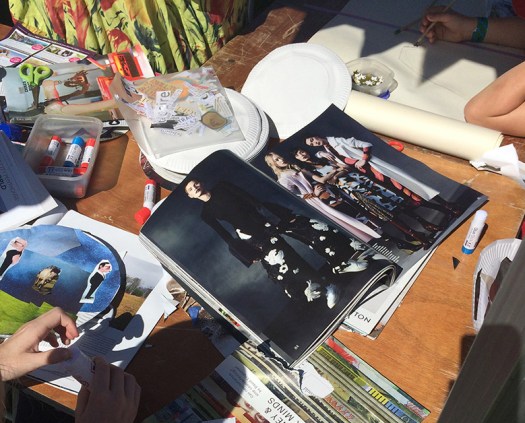
Arriving early Friday morning SEVEN set up our creative space in anticipation of the 4000+ school children who were expected to attend the Next Generation schools’ day at Chalkwell Park. The event is held each year, the day before the Village Green festival organised by Metal Southend and invites local school children to get involved in the arts – from drawing and painting to singing and performing on one of the festival stages.

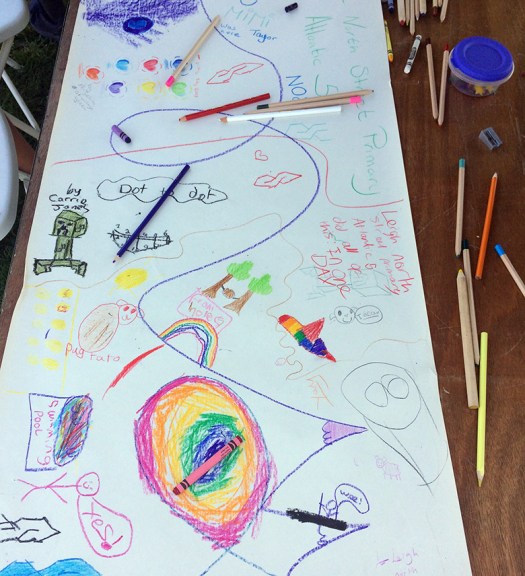
We were offering drop-in sessions for the children and we invited them to either spend time: free-doodling on a continuous roll of paper; creating mandalas from magazines; or creating gift tag art.

It was a very busy morning with a constant flow of groups of children (and teachers) getting stuck in and enjoying their creative freedom.

‘Bling’ was a very common theme among the youngsters, who sought out any form of shiny jewels…

And by the end of the day our continuous roll of paper had been filled with some inspiring creative doodles…

During one of our workshops a teacher commented on how surprised she was to see one pupil sitting still for 20 minutes, whereas she would normally be very disruptive in the classroom. The slow, meditative process of creating something by hand can give the feeling of being ‘lost in the moment’, which in a time when we are surrounded by information 24/7 can be a welcome break.

It was very clear to see the value of creativity on the day and how much the children enjoyed it. At a time when the number of creative subjects being taught in schools has been systematically cut, the work that Metal does in the local community is essential.