3D printed Circular Sock Knitting Machine

I love socks! I began knitting my own socks a few years ago. They were quite complicated to master but once I got it, I got it. At first I tried knitting them on four double-pointed needles, but I didn’t get on with them – too many gaps between the needles. Then I moved on to a small circular needle which gave me much better results.

A selection of my hand-knitted socks

Sock yarn is mostly 4ply (which is quite a thin yarn), so knitting 4ply socks by hand is a very slow process (they can take me about a week to knit one sock).

I first saw a circular sock knitting machine being used on TV (I didn’t even know they existed!) and thought “wow that’s quick”. I had a search for vintage sock machines but when I saw the price I thought “no way”. After more searching I found someone who had used a 3D printer to print a sock machine and thought “ooh!” We have a 3D printer and my husband was up for giving it a try.

The 3D printer files had thankfully been uploaded to Printables.com, so we downloaded them and started printing…

CSM drum being 3D printed

Many prints failed…which is a common occurrence…but after several months we eventually printed all the parts…over 40 in total!

Over 40 x 3D printed parts

Next step – “how on earth does this all fit together??”

CSM construction begins

Thankfully the printer came with instructions. I did find them a little tricky to understand, but I go there…eventually.

My 3D printed Circular Sock Machine

Woop! Woop! Testing was a very exciting stage. Slowly turning the handle I needed to check everything was working properly: make sure the handle cranked; the drum collar rotated around the drum; the stitch counter incremented with each turn; and the cams moved the needles up and down as the handle cranked. Yes!

Ok, now I needed to work out how to knit…and cast on!! Everyone online talked about a cast-on bonnet. I’d never heard of this. But once I made one it made casting on a breeze.

After a few test pieces (that involved lots of yarn dropping off needles, and me learning how to pick up stitches) I was finally ready to make my first sock…

My first CSM sock in progress

After a very steep learning curve, and numerous headaches, I have managed to crank out a recognisable sock!

My first CSM sock

There is still plenty to learn, but for my first attempt I’m very excited by the results. Just need to make a matching sock now!

Alpaca socks

I am becoming obsessed with alpacas. Their crimped fringe is so cute but more importantly their fleece is super soft, it doesn’t contain lanolin like sheep’s wool, so there’s no itch! The wool is also very lightweight and breathable.

There are a number of smallholdings with alpacas popping up everywhere in the UK and I enjoyed a visit to Blackwater Alpacas a couple of years ago where we took an alpaca, named Curly, for a walk.

Walking Curly at Blackwater Alpacas

Since then, I’ve been looking at ways to bring alpaca wool into my craft business. As I am often cold I’ve already been making fingerless gloves and scarves, so I thought “what about socks?”

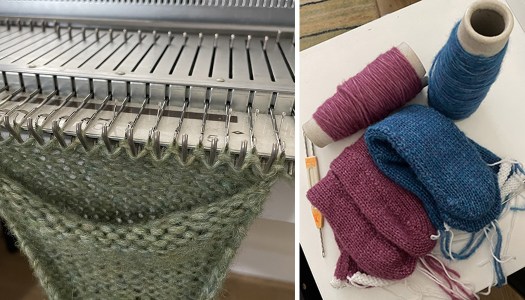
I have an old chunky Knitmaster knitting machine and I wanted to try using it to make socks, so I bought some chunky alpaca wool and had a go…

Alpaca wool

It took many failed attempts and hours of watching YouTube tutorials before I finally got results that resembled socks.

Sock knitting on my old Knitmaster machine

Each sock was knitted on the machine and the cuff was finished off by hand. The finishing touch was to design a packaging sleeve for them.

Alpaca socks

My alpaca socks are £20 a pair and are made to order. DM me if you would like to enquire or to place an order. Thanks!

2022 highlights

Handmade crochet accessories – fingerless gloves, cowls and hats

The main highlight of 2022 has to be dipping my toe into the world of artisan craft fairs!

As with any new venture I always find myself spiraling in towards the intended goal before I reach it. So this journey hasn’t been any different and this is how I’ve gone about it:

Step 1: Help a friend with her stall. Back in June I wanted to gain the experience of being at a craft fair without the risk of doing a craft fair. The day included: pickup, drive, unload, (drive back to collect a forgotten item!), set up, hang out for the day, meet and greet potential customers, cover the stall for little breaks, pack down, drive, drop off. The day flew by!

Step 2: Take part in Open Studios. In early October I moved into a new studio and in mid October we had Open Studios – Phew! Challenging to get everything set up but it was a really good weekend with a few sales to boot.

Step 3: Share a craft stall with friends at different craft fairs. In November and December I shared stalls with friends at three local craft fairs, which was a really good experience. I only had half a stall which meant less space (but less stock was needed!), plus it was half the cost. I also had support throughout the day and gained lots of knowledge from the wealth of their craft fair experience.

Step 4: Have my own stall at a craft fair. This is my aim for 2023 and I have applied for a few fairs that take place early in the year, which I’m waiting to hear back from. Watch this space! Very exciting 🙂

Working up some crochet gloves at the Folk & Bespoke Artisan Fair, Rayleigh Mill. (Photo courtesy of F&B)

I would like to say a huge thank you to everyone who has visited the fairs, liked my posts, followed me on social media, my customers and everyone who has supported me – it’s been a lot of fun so far!

Hope to see you in 2023!

BTW: I will be selling throughout the year via Instagram and in person from my studio at Hadleigh Old Firestation. I also take commissions, so if there is a bespoke size or colour you’d like, please DM me to discuss: hello@jobund.co.uk

My first craft fair

Folk & Bespoke artisan craft fair flyers

I’ve been interested in doing a craft fair for a long time. I also know a growing number of people around me who take part in them regularly, which has inspired me to finally take the plunge!

I initially helped a friend with her stall back in June, just to get some experience and to see if I would like it, and I really enjoyed it. She then very kindly asked if I would like to share her stall in November – I jumped at the chance. But then the nerves took over and the more practical questions began…’how much stock do I need?’, ‘what prices do I sell my items for?’, ‘how will I transport everything to the fair?’ etc etc

Luckily I had already decided WHAT I would sell, as over recent months I have received a lot of interest in my crochet wrist warmers. I personally love these and have made a few pairs for myself as my hands are ALWAYS cold! I wanted a simple design with a thumb hole so that I could still use my fingers while keeping my wrists and hands toasty warm. They have since been snapped up by other craft stall holders, artists and dog walkers and they make the perfect gift.

A selection of my wrist warmers on display

To compliment the wrist warmers I also made matching cowls, scarves and slouchy hats. These are a few of the items I had on display.

Crochet accessories on display

The display is a work in progress but for a first attempt I think it worked ok. I had varying heights, a space to stash my notebook and water bottle and a long table covering to hide everything under the table. I had also bought a Sumup machine to enable me to take card payments. It was sooo easy to use and accounted for about 90% of my sales on the day! Well worth the investment (in the initial purchase and in the time for setting up the stock items).

I’m now busy making new stock for my upcoming Christmas Craft Fairs, see dates below…

Upcoming craft fair dates where you can find me:

Sat 19 Nov – Christmas Eco Fayre at Leigh Road Baptist Church, SS9 1NN
Sat 10 Dec – Folk & Bespoke Artisan Craft Fair, Leigh Community Centre, SS9 1SP
Sat 17 Dec – Folk & Bespoke Artisan Craft Fair, Mill Arts & Events Centre, SS6 7ED

I also take commissions, so if you have any specific requirements please drop me an email at hello@jobund.co.uk, or pop along to one of the craft fairs above, and we can discuss them 🙂

Vintage postcard embroidery workshop

Pink blossom – Jo Bund

The journey of a holiday postcard

In the pre-digital age, it was quite common to send a postcard home to friends and family, during your holiday. You’d pick out a selection of cards, write a brief message on the back and post them off. When they arrived at their destination, they would be read, put away in a drawer, and then probably forgotten about. At some point in the future, when the drawer is cleared out, the cards will either be given away or thrown in the bin.

Often, when you go to boot fairs or second hand book shops, you’ll find boxes of old photos and postcards that have been discarded.

So, what happens next?

It seems a shame to throw old postcards and photos away, as they are a piece of social history. But what can you do with them?

I’ve recently pondered this thought and came across a couple of artists who give old postcards a new lease of life by embroidering on to them:

FRANCESCA CRAMER – is an Italian textile artist and designer, based in North Wales. She describes her postcards as having “a conversation with the past, like lifting a layer of dust and letting the colour through, adding another chapter.”

Her technique varies from piece to piece where she either:

  • adds something new;
  • colours over a feature of the photograph; or
  • erases something completely.
Francesca Cramer embroidered postcard examples

HAN CAO – is a self-taught artist, living in Palm Springs. She uses embroidery to create new narratives for long-forgotten photographs and postcards found at flea markets and antique shops from around the world.

Her aim with these examples is to bring life to lost images, telling new narratives from the past through thread and colour:

Han Cao embroidered postcard examples

My workshop idea

I’d been asked to run a workshop at my local Embroiderer’s Guild and thought this would be an interesting idea to share with them. Being based in Southend-on-sea, thousands of postcards have been sent from here over the years. So I sourced some old postcards of Southend-on-sea, and the surrounding area, from the early 1900s to the 1970s.

I asked the group to choose a postcard each. The postcards themselves created an interesting discussion as the images brought back fond memories for people who had grown up in the area.

I wanted them to think about how they could change the image they had chosen and bring it to life…create their own story…

I suggested they keep their stitches simple – e.g. french knots, cross stitch, kantha stitch – for maximum effect. Stitching into card is very different to fabric – once the hole is pierced it’s permanent, and if you pierce holes too close together they can create one big hole!

TIP: I would always pierce holes in the card first before beginning to stitch and place a cork mat underneath the card for protection.

Embroiderer’s Guild workshop

The results were quite varied especially as some found the idea of stitching into an old postcard a little troubling! But everyone did have a go.

Before and After postcard by Jo Bund